

Whether you are pregnant and weighing your options, or hoping to welcome a child into your family, the adoption process can look like a wall of paperwork, waiting, and unfamiliar language. It is more manageable than it looks — it just needs to be broken into stages.
This guide walks through every stage of the adoption process, from the first phone call to the day the adoption is finalized in court. You will find realistic timelines, honest cost ranges, the legal terms you will hear along the way, and what Indiana law specifically requires.
Tapestry Adoptions is a licensed, nonprofit, full-service adoption agency serving families across Indiana. Our counseling is free and confidential for expectant parents, with no obligation to place. If you would rather talk it through with a person than read a web page, call (317) 529-7322 any time.
What Is the Adoption Process?
Adoption is the legal process that permanently transfers parental rights and responsibilities from a child’s birth parents to their adoptive parents. It is finalized by a judge, and once complete it is permanent: the adoptive parents become the child’s legal parents in every sense, and a new birth certificate is issued.
Everything between the first phone call and that court date exists to make sure the decision is informed, voluntary, and right for the child. That is why there are home studies, counseling requirements, waiting periods, and consent laws.
Terms You'll Hear
- Adoption plan — the set of choices an expectant parent makes about the adoptive family, the hospital stay, and future contact.
- Home study — a licensed social worker’s assessment of a prospective adoptive family’s home, background, finances, and readiness. Required in every adoption.
- Matching — the point at which an expectant parent and a waiting family choose each other.
- Consent — the legal document a birth parent signs to allow the adoption to proceed.
- Placement — when the child goes home with the adoptive family, before the adoption is legally final.
- Post-placement supervision — visits by a social worker between placement and finalization.
- Finalization — the court hearing that makes the adoption permanent.
- Open, semi-open, and closed adoption — the level of ongoing contact between the birth family and the adoptive family, decided as part of the adoption plan.
The 7 Stages of the Adoption Process
Almost every adoption, whatever the path, moves through the same seven stages. What changes between paths is how long each one takes and who is involved.
Stage 1: Information and Counseling
Everything starts with a conversation, not a commitment. Expectant parents meet with a counselor to talk through parenting, adoption, and every option in between. Hopeful adoptive families attend an orientation and decide which adoption path fits their circumstances. At Tapestry, this stage costs an expectant parent nothing and carries no obligation.
Stage 2: Building the Adoption Plan
An expectant parent decides what they want the adoption to look like: the kind of family they are looking for, who is in the delivery room, whether they want to meet the family beforehand, and how much contact they want afterward. Nothing here is locked in — plans change, and that is normal.
Stage 3: The Home Study (Adoptive Families)
Every adoptive family completes a home study before a child can be placed with them. It includes criminal and child-abuse background checks, financial verification, medical statements, personal references, interviews, and at least one in-home visit. Most home studies take about three to six months, and the biggest cause of delay is slow paperwork rather than anything a social worker finds. It is not a test to be passed — it is a safety check and a preparation process.
Stage 4: Matching
Expectant parents review profiles of approved waiting families and choose. Some choose from photos and letters alone; others want a phone call or a meeting first. Once both sides agree, the match is made and everyone starts preparing for the birth.
Stage 5: Birth, Hospital Stay, and Consent
The hospital plan written in Stage 2 guides who is present, who holds the baby first, and how much time the birth mother wants alone with her child. After the birth — and only after the birth — the birth mother may sign her consent to the adoption. Indiana law is specific about how and when this happens; see the Indiana section below.
Stage 6: Placement and Post-Placement Supervision
The child goes home with the adoptive family. A social worker then visits several times over the following months to confirm the child is thriving and to write the report the court will rely on. Counseling and support for the birth parents continue through this period — this is when support matters most, and it is also when it is most often dropped.
Stage 7: Finalization
A judge reviews the file and issues the adoption decree. The adoptive parents become the child’s legal parents, and an amended birth certificate is issued. Finalization usually happens six months to a year after placement, depending on the county and the type of adoption.
A note that belongs on the page: the process does not end at finalization. Adoption is a lifelong relationship for everyone in it, and post-adoption counseling, support groups, and openness agreements matter for years afterward.
The Adoption Process for Birth Parents in Indiana
If you are pregnant and considering adoption, you are in control of this process from beginning to end. Here is exactly what working with Tapestry looks like.
1. Reach Out — Free and Confidential
Call, text, or fill out the form on this page. You will talk with an experienced counselor who will answer your questions and explain your options. There is no cost, no pressure, and no obligation to place your baby for adoption. You can call to gather information and decide to parent — that happens, and it is a good outcome.
2. Build Your Adoption Plan
Together we will map out what you want: the qualities you are looking for in an adoptive family, where they live, their faith or values if that matters to you, and how much ongoing contact you would like. You will review profiles of waiting families and choose the one that feels right.
3. Prenatal Care and Practical Support
We help you access prenatal care and medical services. Indiana law also permits adoptive families to cover certain approved pregnancy-related expenses, subject to court review — we will explain in plain language what is and is not allowed in your situation, so there are no surprises.
4. Choose Open, Semi-Open, or Closed
Most adoptions today involve some level of ongoing contact, and research consistently supports openness as good for children. You decide what that looks like: letters and photos, video calls, in-person visits, or no contact at all. We will help you put your agreement in writing so everyone shares the same expectations.
5. Your Hospital Plan
Before your due date, we write down your wishes for the hospital: who is in the room, whether you want time alone with your baby, who feeds and holds the baby, and whether the adoptive family is present. Hospital staff follow the plan you set.
6. Consent and Your Legal Rights in Indiana
Under Indiana law, a birth mother cannot sign consent to an adoption before her baby is born. Consent may only be executed after the birth, and it must be signed in the presence of a court, a notary public or other authorized official, or an authorized agent of a licensed child placing agency or the Department of Child Services.
After consent is signed, Indiana law allows it to be withdrawn within 30 days — but only if the court finds that withdrawing consent is in the child’s best interests and enters an order allowing it. Consent also becomes irrevocable earlier than 30 days if the person who signed it appears before the adoption court and acknowledges that they understood the consequences and signed freely and voluntarily.
This is one of the most important things to understand before you sign anything, and it is worth going through slowly with your counselor and an attorney. We will make sure you have both.
7. Support That Continues After Placement
Placement day is not the end of our relationship. Counseling, support groups, and help managing your openness agreement remain available to you at no cost for as long as you want them.
The Adoption Process for Hopeful Adoptive Families
If you are hoping to adopt, the path runs in roughly this order:
- Decide on your adoption path. Domestic infant, foster care, kinship, stepparent, or international — each has a different timeline, cost, and set of requirements.
- Choose a licensed agency or attorney. Ask what post-placement support they provide, how they handle birth family communication, whether every fee is disclosed up front, and what happens financially if a match does not proceed. A reputable agency will answer all four without hesitating.
- Complete your home study. Three to six months, typically. Start gathering documents early.
- Create your family profile and wait to be chosen. This is the hardest stage emotionally, and the one nobody can put a firm date on.
- Match, prepare, and place.
- Complete post-placement visits and finalize in court.
Two things worth saying plainly: expect the timeline to take longer than you plan for, and expect that a child joining your family through adoption carries a real loss alongside the joy. Families who prepare for both — with education, a trauma-informed pediatrician, and a therapist they already know — do better than families who do not.
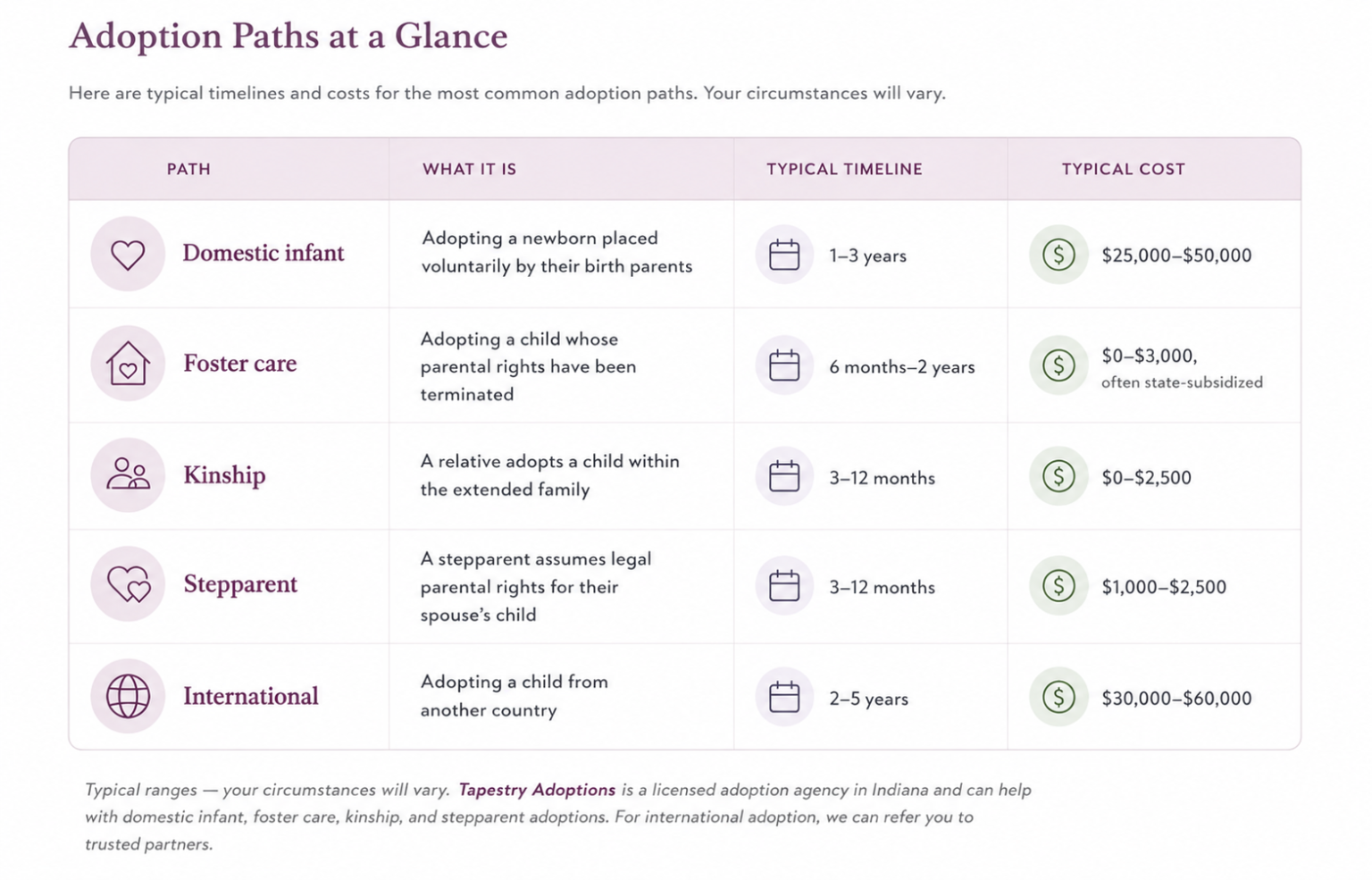
How Long Does the Adoption Process Take?
There is no single answer, but here is a realistic frame. For adoptive families pursuing domestic infant adoption, expect three to six months for the home study, then anywhere from a few months to a few years of waiting to be chosen, then six months to a year between placement and finalization. Foster care adoption often moves faster once a child is legally free. Kinship and stepparent adoptions are usually the quickest.
For a birth parent, the timeline is shaped by your pregnancy, not by an agency queue. You can call at 8 weeks or at 38 weeks — or after your baby is born — and we can still help.
The single biggest cause of delay across every path is incomplete paperwork. Staying organized genuinely shortens the process.
How Much Does Adoption Cost and What Help Is Available?
If you are placing a child for adoption, it costs you nothing. Birth parents never pay adoption fees. Counseling, legal representation, and support are provided at no cost to you.
For adoptive families, cost depends on the path (see the table above). Fees typically cover agency services, the home study, legal filings, counseling for all parties, post-placement supervision, and — in domestic infant adoption — approved birth mother expenses.
The Federal Adoption Tax Credit
For tax year 2026, the federal adoption credit covers qualified adoption expenses up to $17,670 per child, up from $17,280 in 2025. Recent legislation made part of the credit refundable for the first time: up to $5,120 can be refunded for tax year 2026 even if you owe no federal tax. Unused refundable amounts cannot be carried forward. Families adopting a U.S. child with special needs may be able to claim the full credit regardless of actual expenses.
Talk to a tax professional about your own situation — these rules changed recently and are easy to get wrong.
Other Ways Families Fund Adoption
- Employer benefits — a surprising number of employers offer adoption assistance. Ask HR early.
- Grants — national and faith-based adoption foundations award grants each year.
- Adoption loans — available with terms designed around adoption timelines.
- Foster care subsidies — states often cover legal fees and provide ongoing monthly support for children adopted from foster care.
- Community fundraising — crowdfunding and church or community support.
For a birth parent, the timeline is shaped by your pregnancy, not by an agency queue. You can call at 8 weeks or at 38 weeks — or after your baby is born — and we can still help.
The single biggest cause of delay across every path is incomplete paperwork. Staying organized genuinely shortens the process.
How to Start the Adoption Process
You do not need to have anything figured out before you make the first call. Starting looks like this:
- Decide which side of the process you are on — placing a child, or hoping to adopt.
- Contact a licensed agency and ask for an information conversation. It is free, and it commits you to nothing.
- Ask the hard questions early — about fees, timelines, support after placement, and what happens if you change your mind.
- Take the next small step — an orientation, a counseling session, a home study application.
Tapestry Adoptions is licensed in Indiana with offices in Indianapolis, South Bend, and Nashville, Indiana, serving the entire state. Call (317) 529-7322 or use the form below.
Frequently Asked Questions
What are the stages of the adoption process?
Seven: information and counseling, building the adoption plan, the home study, matching, birth and consent, placement and post-placement supervision, and finalization in court.
How do I start the adoption process?
Contact a licensed adoption agency and ask for an information conversation. It costs nothing and commits you to nothing. From there you will either begin counseling and build an adoption plan, or begin a home study.
Can a birth mother change her mind?
In Indiana, consent cannot be signed before the baby is born. After it is signed, it may be withdrawn within 30 days if the court finds that doing so is in the child’s best interests and enters an order allowing it. It becomes irrevocable sooner if the person who signed it appears in court and confirms the consent was given knowingly and voluntarily.
Does it cost anything to place a baby for adoption?
No. Birth parents never pay adoption fees. Counseling and legal representation are provided at no cost.
How much does it cost to adopt a child?
It depends on the path. Domestic infant adoption typically runs $25,000–$50,000; foster care adoption is often free or state-subsidized; kinship and stepparent adoptions usually cost under $2,500. The federal adoption tax credit covers up to $17,670 per child for tax year 2026, with up to $5,120 refundable.
How long does the adoption process take?
Domestic infant adoption commonly takes one to three years from application to finalization. Foster care adoption often takes six months to two years. Kinship and stepparent adoptions are typically the fastest.
What is the difference between open and closed adoption?
Open adoption involves ongoing contact between the birth family and the adoptive family — letters, calls, or visits. Closed adoption involves no contact. Semi-open adoption sits in between, usually with contact routed through the agency. The birth parents choose.
Do I need a lawyer to adopt?
Yes — every adoption is finalized in court and requires legal filings. A full-service agency coordinates this for you and ensures birth parents have independent legal representation.
Talk With Tapestry Adoptions
Tapestry Adoptions is a licensed, nonprofit, full-service adoption agency serving families throughout Indiana, with offices in Indianapolis, South Bend, and Nashville, Indiana. Whether you are pregnant and exploring your options or hoping to grow your family, the first conversation is free and confidential.
Contact Us
Get In Touch
We are here to answer your questions with no obligation. We will give you all the information you need to make the best decision for you and your child.
7399 N. Shadeland, BOX 150
Indianapolis, Indiana 46250
United States
Email:
Phone:

Get in touch
I’d Like To Talk With Someone About My Options
"*" indicates required fields

Disclaimer: Tapestry takes seriously the responsibility of providing appropriate adoption education, which includes adoption language. There are terms used throughout the website such as "Give away my child for adoption" which are not recognized as adoption sensitive language. This terminology is used for the sole purpose of search engine requirements for mothers seeking to make an adoption plan.
We value your privacy
We use cookies to enhance your browsing experience, serve personalized ads or content, and analyze our traffic. By clicking "Accept", you consent to our use of cookies.
Functional
Always active
The technical storage or access is strictly necessary for the legitimate purpose of enabling the use of a specific service explicitly requested by the subscriber or user, or for the sole purpose of carrying out the transmission of a communication over an electronic communications network.
Preferences
The technical storage or access is necessary for the legitimate purpose of storing preferences that are not requested by the subscriber or user.
Statistics
The technical storage or access that is used exclusively for statistical purposes.
The technical storage or access that is used exclusively for anonymous statistical purposes. Without a subpoena, voluntary compliance on the part of your Internet Service Provider, or additional records from a third party, information stored or retrieved for this purpose alone cannot usually be used to identify you.
Marketing
The technical storage or access is required to create user profiles to send advertising, or to track the user on a website or across several websites for similar marketing purposes.